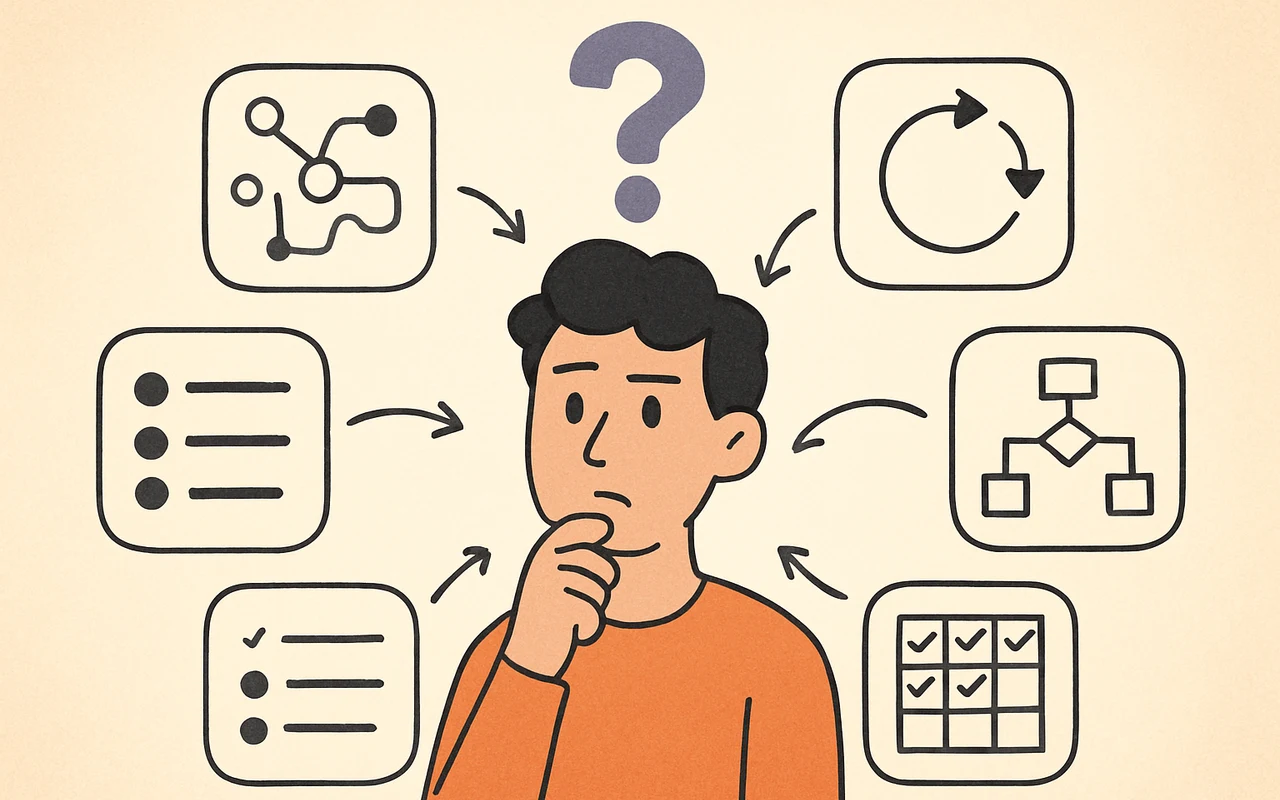
A decision-making framework is a structured way to evaluate options and choose a course of action from the information you have. No single framework fits every situation. A quick, reversible choice and a slow, high-stakes one call for different tools.
This guide covers five widely used frameworks, what each is good at, and a simple filter for choosing between them.
Five Frameworks and What Each One Solves
1. Cynefin: Understand the Problem First
Cynefin is a sense-making model developed by Dave Snowden. It does not pick an option for you. It sorts your situation into one of five contexts: Clear (sometimes called Obvious), Complicated, Complex, Chaotic and Confused. Each context needs a different kind of response.
Use it when you are unsure what kind of problem you are facing. A routine process failure and a market shift nobody has seen before should not be handled the same way.
2. OODA Loop: Decide Fast and Adjust
The OODA loop has four steps: observe, orient, decide, act. You then repeat the loop with whatever you learned. It favors speed and iteration over exhaustive analysis.
It suits reversible, low-stakes decisions. If a wrong call is cheap to undo, acting and correcting beats deliberating for days.
3. RAPID: Settle Who Decides
RAPID stands for recommend, agree, perform, input, decide. It assigns each person a role so that it is clear who proposes, who must sign off, who supplies information and who makes the final call. It is aimed at situations with multiple stakeholders where responsibility is blurry.
Do not confuse it with RACI (responsible, accountable, consulted, informed). RACI maps roles for executing work. RAPID maps roles for making a decision.
4. DACI: Create Accountability in Groups
DACI assigns roles for group decisions: driver, approver, contributors and informed people. Atlassian says it likes DACI for creating urgency and accountability. One named driver keeps a decision moving, and one approver keeps it from being relitigated.
Think of a team choosing a new tool. The driver gathers requirements and options, contributors weigh in, and the approver signs off.
5. Weighted Decision Matrix: Compare Options Fairly
A weighted decision matrix lists your options as columns and your criteria as rows. You give each criterion a weight, rate each option against it, and total the weighted scores. It is useful when several options compete on several factors, such as comparing phones on price and battery life.
The method forces you to state what matters before you look at the options. Some decision apps, such as Decision Maker: Smart Choices, offer this kind of matrix with 1-10 ratings and a weighted sum.
How to Choose the Right One
One practical approach is a three-question filter:
- Is the decision reversible?
- How high are the stakes?
- How much time do you have?
If the answers are reversible, low stakes and little time, lean on a speed framework such as the OODA loop. If the decision is irreversible and high-stakes, use a thoroughness framework such as a weighted matrix or a pre-mortem. A pre-mortem means imagining the decision has already failed and working backwards to find out why.
Next, match the framework to how your decisions usually fail. If they stall because nobody owns them, fix decision rights first with RAPID or DACI. Comparing options will not help if no one has the authority to choose. If you keep misreading the situation itself, start with Cynefin. If you keep over-analyzing small choices, practice the OODA loop.
Limitations and Trade-Offs
Frameworks reduce bias and help ensure relevant factors are considered, but they do not remove judgment. A weighted matrix looks objective, yet the weights and ratings are still your opinions. A false sense of precision is a real risk.
Role-based frameworks like RAPID and DACI add process. For a two-person decision, that overhead may cost more than it saves. Speed frameworks can also push you to act before you understand a problem, which is where Cynefin helps.
Most real decisions combine tools. You might use Cynefin to classify a problem, DACI to assign roles and a matrix to compare the final candidates.
Conclusion
Match the method to the decision. Use speed tools for cheap, reversible choices and thoroughness tools for costly, permanent ones. Use role-based frameworks when ownership is the real bottleneck.
Start with one framework on your next real decision rather than learning all five at once. Afterward, note whether it helped, and adjust your choice next time.