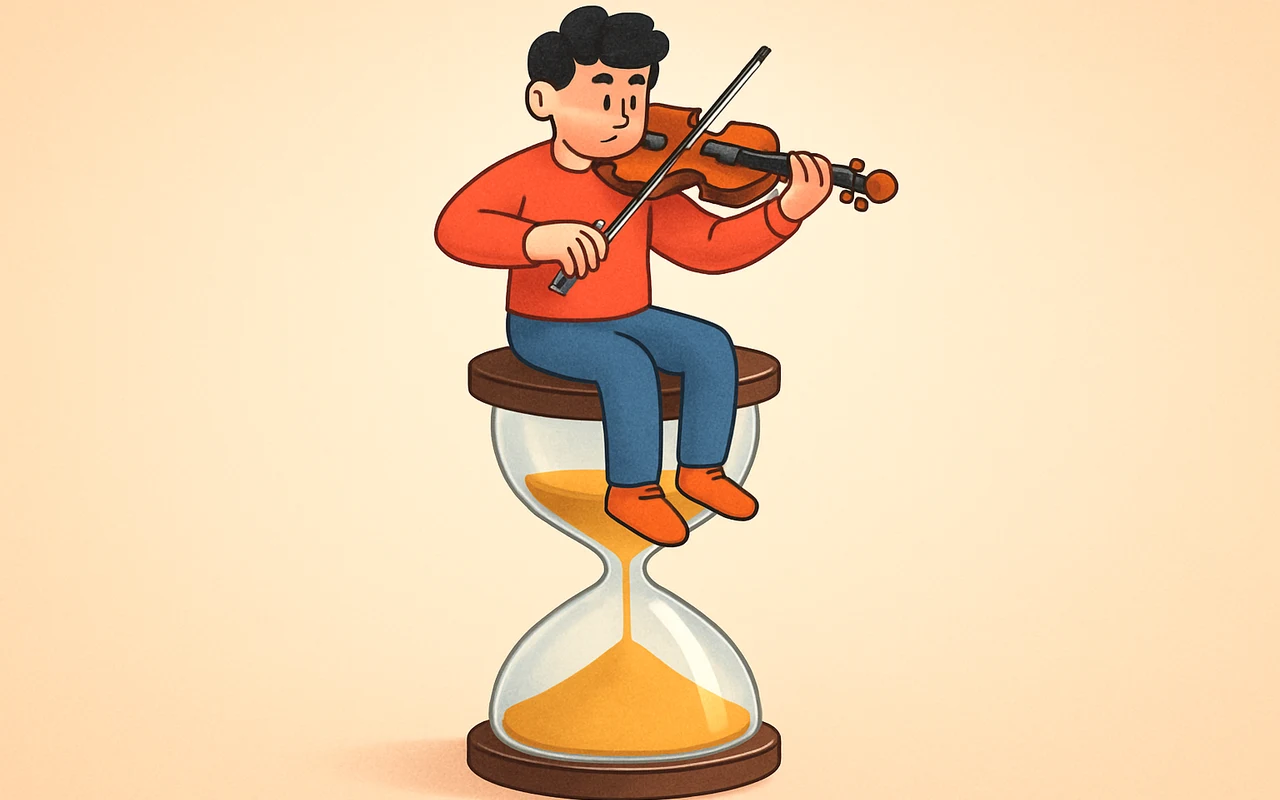
The 10,000-hour rule says that you need roughly 10,000 hours of practice to become an expert. It is a catchy number, but it is often treated as a magic threshold, which it is not.
The useful part of the idea is not the number. It is the kind of practice behind it, and that is what this article covers.
Where the Rule Comes From and What It Really Says
The rule was popularized by writer Malcolm Gladwell in his 2008 book Outliers. He drew on research by psychologist Anders Ericsson, who studied violinists at a Berlin music academy. The best students had accumulated about 10,000 hours of practice by age 20, while less accomplished students had logged far fewer.
Ericsson later pushed back on the simplified version. He pointed out that the figure was an average, not a rule. Some of the top violinists had not reached 10,000 hours, and the number says nothing about chess, programming, or sports, where the time needed varies widely.
Three common misunderstandings are worth clearing up:
- It is not a guarantee. Reaching 10,000 hours does not automatically make you an expert.
- It is not a universal number. Different fields demand different amounts of time.
- It is not about any hours. Time spent repeating what you already do well barely counts.
Deliberate Practice: The Part That Matters
Ericsson's actual finding was about deliberate practice. This means focused effort aimed at a specific weakness, with immediate feedback, at a difficulty slightly beyond your current ability.
Compare two players of a competitive video game. One plays hundreds of matches on autopilot. The other reviews replays, identifies one recurring mistake such as poor positioning, and drills it in a practice mode. The second player will almost certainly improve faster in far fewer hours.
The Core Ingredients
- A specific goal. Instead of "get better at guitar," aim for "play this chord change cleanly at 80 beats per minute."
- Full attention. Distracted practice builds weaker skills than short, concentrated sessions.
- Fast feedback. A coach, a recording, test results, or a replay shows you what is going wrong.
- Stretching your limits. Work should feel challenging, not comfortable.
- Rest. Deliberate practice is mentally tiring, so sessions are usually limited and recovery matters.
Applying It in Everyday Life
You do not need to count to 10,000. Use the idea to structure how you spend the time you have.
- Pick one skill. Spreading effort across many goals slows progress in all of them.
- Break it into sub-skills. A programmer might separate debugging, reading other people's code, and designing data structures.
- Find a model. Study how experts perform, then compare your own work against theirs.
- Schedule short, focused blocks. Even 45 to 90 minutes of concentrated work a day adds up over months.
- Track and review. A simple log of what you practiced and what went wrong helps you adjust.
Tools can help here, such as a notes app for a practice journal, a screen recorder for reviewing gameplay or coding sessions, or a timer to keep blocks honest. The tool matters less than the habit of reviewing results.
Limits and Caveats
Practice is not the only factor. Later research found that deliberate practice explains a meaningful share of performance differences, but the share varies by field. It tends to matter most in structured, predictable areas like music and chess, and less in areas where other factors play a larger role.
Starting age, access to good teachers, physical traits, and opportunity also play a part. Ten thousand hours is also a very long commitment, roughly three hours a day for a decade. Most people do not need expert-level mastery to gain real benefit, and a few hundred hours of well-designed practice can take you surprisingly far.
Final Words
The 10,000-hour rule works best as a reminder that skill takes sustained effort, not as a literal target. What counts is how the hours are spent.
Choose a clear goal, practice at the edge of your ability, seek feedback, and rest enough to keep going. Do that consistently, and the hours will take care of themselves.