TL;DR
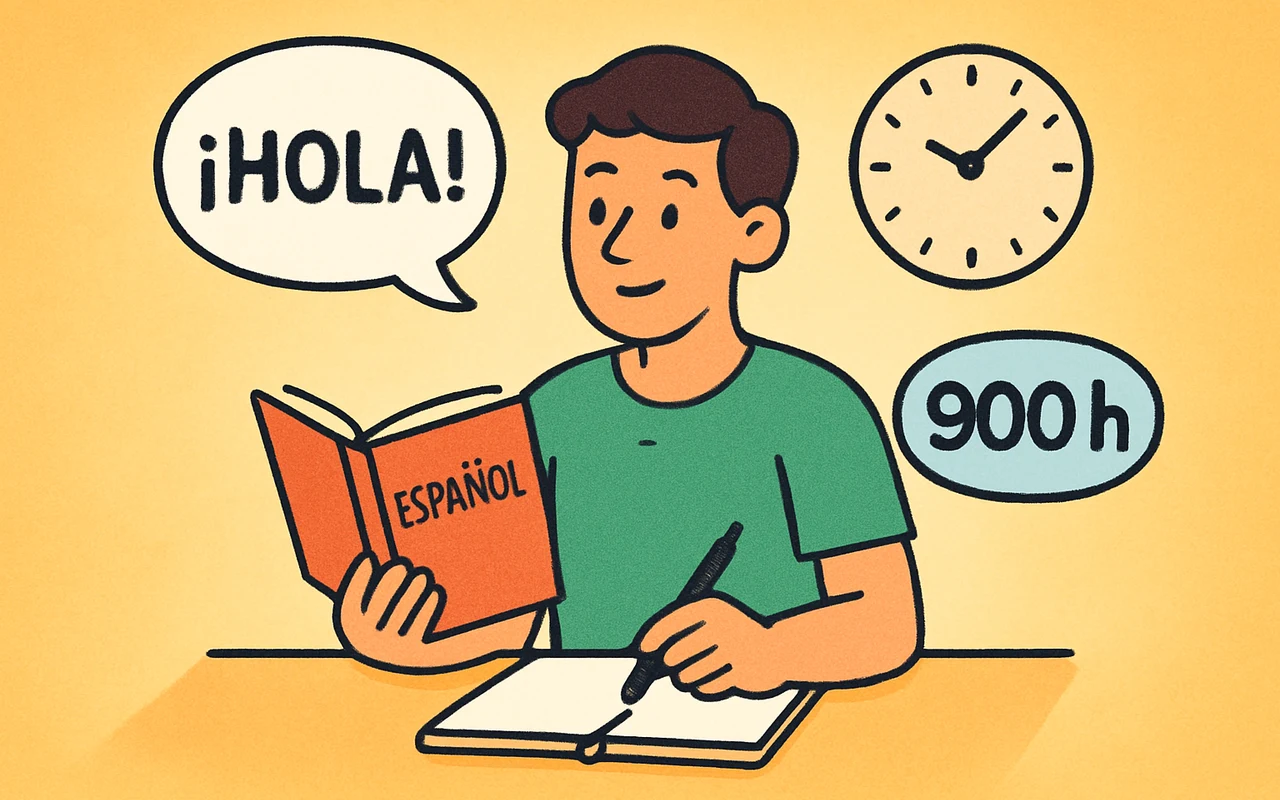
For an English speaker, conversational Spanish usually takes roughly 350 to 400 hours. Solid professional-level Spanish takes about 600 to 700 hours, and the most advanced levels run to 900 or more. Estimates differ by source, so treat them as ranges and measure your own progress in hours rather than calendar months.
What the Benchmarks Say
The most quoted figure comes from the Foreign Service Institute (FSI), a US government language school. It places Spanish in Category I, its group of languages that are easiest for English speakers. The FSI puts Spanish at 30 weeks of full-time study, or about 552 to 690 class hours. Danish, Dutch, Italian, Portuguese and Swedish are rated slightly easier at 24 weeks.
Other guides quote the same estimate as 600 to 750 hours, so the exact number depends on who is reporting it. The goal is also "professional working proficiency," which is well beyond ordering food or chatting with a neighbour.
FSI students do not only sit in class. They average about 23 class hours a week plus 17 hours of directed self-study, close to 40 hours of weekly exposure. Most self-learners cannot match that pace, which is why the calendar time stretches so much.
Common summaries from language-learning guides:
- Basic conversation: 3 to 6 months, or roughly 100 to 200 hours.
- Conversational fluency: 6 to 12 months, or roughly 350 to 400 hours.
- Advanced fluency: 1.5 to 3 years or more, or roughly 600 to 900+ hours.
Hours by CEFR Level
The CEFR (Common European Framework of Reference for Languages) divides ability into six levels, from A1 (beginner) to C2 (near-native). Several guides publish cumulative study hours for each one. Their figures overlap but are not identical, so the ranges below combine the lowest and highest values they give.
- A1: about 70 to 100 hours
- A2: about 150 to 200 hours
- B1: about 300 to 450 hours
- B2: about 500 to 650 hours
- C1: about 700 to 900 hours
- C2: 1,000+ hours, according to one guide
One source places the FSI's professional-proficiency estimate at roughly B2 to C1. The Instituto Cervantes works differently: it assigns course hours per level (60 for A1, 90 for A2, 120 for B1 and 150 for B2) rather than a running total. Those figures describe classroom courses, not everything a learner needs to do.
What that looks like on a calendar
At one hour a day, one guide maps the levels to these timelines:
- A1 in 2 to 3 months
- A2 in 4 to 6 months
- B1 in 8 to 12 months
- B2 in 1.5 to 2 years
- C1 in 2 to 3 years
Daily time changes the picture sharply. Half an hour a day adds up to about 180 hours a year. At 15 minutes a day, one guide estimates 2 to 3 years to reach a typical conversational goal, compared with about a year at an hour a day.
Early results come faster than the totals suggest. Short first conversations are possible within 1 to 3 months at 15 to 30 focused minutes a day, and three months at one hour a day (about 90 hours) is enough for a solid A1.
How to Track Your Own Hours
A total of hours is easier to act on than a vague sense of progress. A simple log is enough, and a notes app, a spreadsheet or a paper calendar all work.
- Pick a target level. Choose a CEFR level and take a midpoint from the ranges above, such as about 375 hours for B1.
- Decide what counts. Lessons, tutoring, focused reading, listening with attention and speaking practice are all reasonable. Background audio you are not following is not.
- Log each session. Record the date, minutes and activity right after you finish, so you do not have to reconstruct it later.
- Review weekly. Add up the week and compare it with your running total and your target.
- Mark milestones. Note when you pass roughly 100, 200 and 350 hours and what you can do at each point, such as holding a five-minute conversation.
Tracking also shows you how long the goal will take at your real pace. If your log shows 3 hours a week, 350 hours is about two and a half years away, which is better to know early than to discover later.
Limits of the numbers
These figures are averages for English speakers and come from different sources with different definitions of fluency. Study quality matters: an hour of speaking with feedback is not the same as an hour of passive scrolling. Your own log is the most useful number you will have, and the published ranges are best used to check it.
Conclusion
Plan for roughly 100 to 200 hours to get started, 350 to 400 for comfortable conversation, and 600 or more for strong, work-ready Spanish. The exact figure depends on your goal, your consistency and how you count your time.
Pick a target, log every session and check the total each week. A steady habit of even 30 minutes a day reaches about 180 hours in a year, and the log will show you how close you are to your goal.