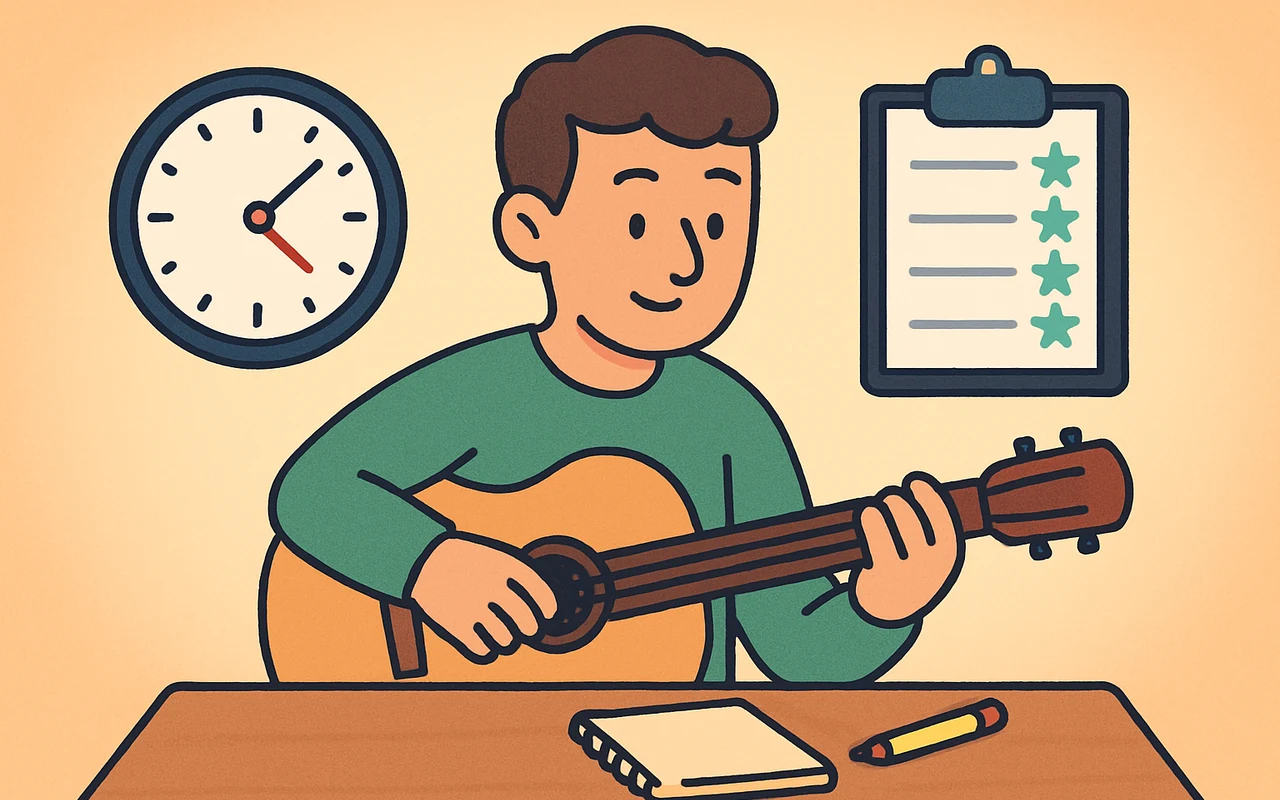
Most practice trackers count hours. The assumption is that more time on a skill means more improvement, but research on expert performance does not support that neatly.
This article explains why the quality of your attention matters more than the length of a session, and how to log it with a simple focus rating.
Why Hours Alone Mislead You
Deliberate practice is a term popularised by psychologist Anders Ericsson. It means structured effort aimed at a specific weakness, done with full concentration. It is different from simply repeating what you already do well.
The idea is often confused with the "10,000-hour rule". Ericsson's 1993 study did not prove that rule, and Ericsson later criticised Malcolm Gladwell's popular version for focusing on the quantity of practice rather than its quality. He and his collaborators argued that researchers should keep a strict definition and measure how good the practice was, not just count hours.
One frequently cited study of violinists found that the best performers were not distinguished mainly by total hours. They practised more deliberately, with focused attention on their weak spots.
Another concept explains why hours mislead. Ericsson described an OK plateau: once a skill becomes automatic, the brain stops actively engaging and improvement stalls. You can keep logging time and feel productive while nothing changes.
Some figures in circulation put practice at roughly 26% of skill differences in games, 21% in music and 18% in sports. Treat them as rough, since they come from a secondary summary. They still hint that raw hours leave most of the variation unexplained.
What Counts as Focused Practice
A practical version of deliberate practice has four conditions for each session:
- A measurable target, such as "play bars 12-16 at 80 bpm without errors" rather than "practise piano".
- Concentration, meaning no TV, no phone and no mind-wandering.
- Fast feedback, from a coach, a recording, a score or an engine analysis.
- Raised difficulty, so the task sits just beyond what is comfortable.
Because concentration is demanding, it cannot be stretched indefinitely. Guides on the subject recommend short, intense sprints with breaks instead of long sessions at reduced intensity. One popular claim is that thirty minutes of fully focused work can beat two hours of distracted repetition. That is a rule of thumb, not a law, but the direction is consistent across sources.
There is also a trap in tracking itself. You can log practice and still reinforce the old habit. If a session repeats a mistake, the hours recorded do not mean the mistake is being fixed.
How to Log Focus Quality in Practice
The simplest method is to add one number and one sentence to every session log. Use a scale you can apply in a few seconds, such as 1 to 5.
- Write the target before you start.
- Practise with the timer running and distractions removed.
- Rate your focus right away, while the session is fresh.
- Add a short note on what you worked on and what went wrong.
Some apps already support this workflow. 10,000 Hours - Mastery Tracker, available on iOS and Android, has a built-in session timer and prompts you to rate how focused you felt afterwards. It also shows a focus quality distribution, the best time of day and your most productive weekday. The app is primarily a time tracker, so the focus rating is an add-on rather than its core. Its Google Play listing shows an update on Oct 12, 2026. A notebook or spreadsheet with the same two columns works just as well.
After a few weeks, compare the ratings with your results. You may find that your 5-rated sessions are short and early in the day, while long evening sessions score a 2. That tells you to schedule differently, not to try harder.
Limits of the Approach
A focus rating is subjective. Your standards may drift, and a session can feel intense without targeting the right skill. Concentration is necessary but not sufficient: a perfectly focused hour spent on the wrong exercise still wastes the hour.
Ratings also should not turn into a new score to chase. If the goal becomes a streak of 5s, you may pick easy tasks to feel focused, which defeats the point of raising difficulty. Pair the rating with an external check, such as a recording, a test result or a match outcome.
Conclusion
Time spent is a measure of exposure, not of learning. Logging how focused each session was, and what you aimed at, brings you closer to what research actually describes as effective practice.
Start small: set a target, work in short sprints, and give each session a quick rating. Patterns in those numbers will tell you more than a total of hours ever could.