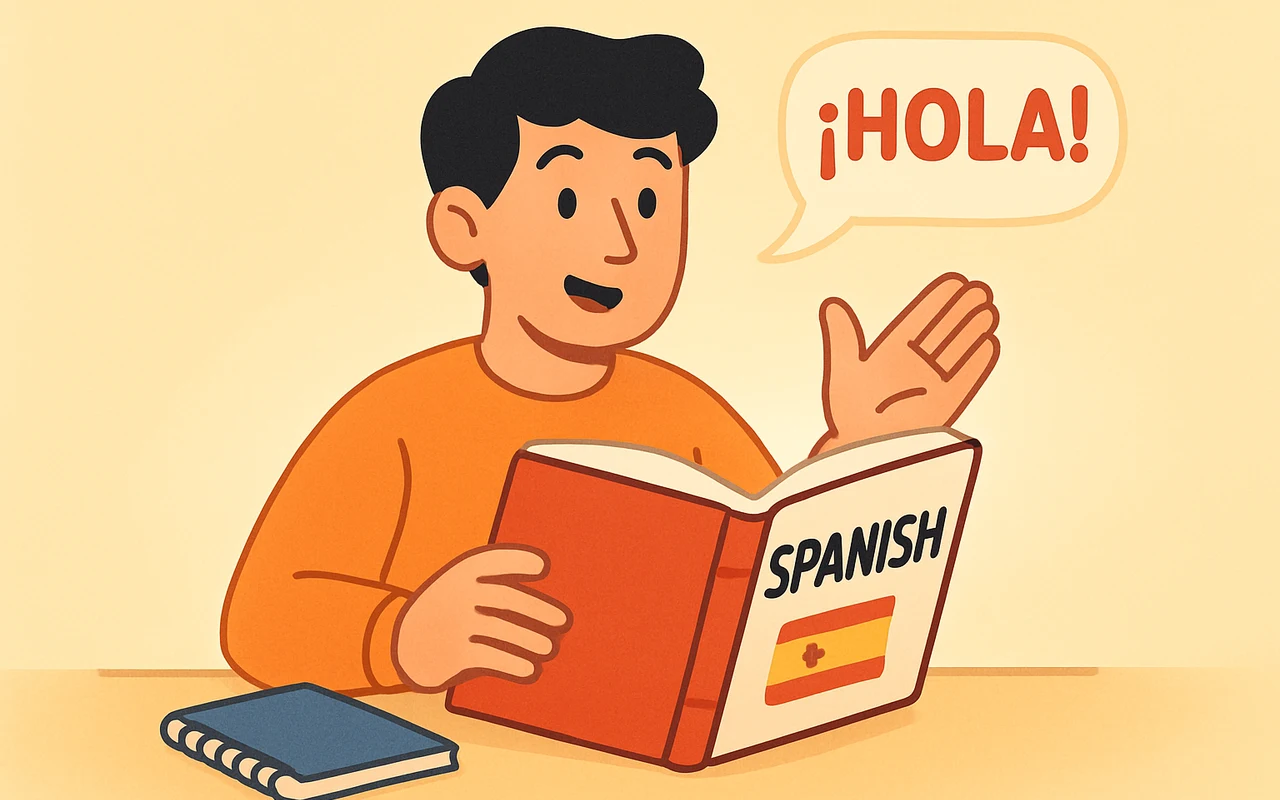
Most language advice fails because it is vague. "Practice every day" does not tell you how much, or what kind. The 600-hour plan fixes this by setting a fixed budget: about 600 hours of deliberate study in 12 months.
That works out to roughly 100 minutes a day, or 12 hours a week. For an English speaker learning Spanish, this is enough to hold everyday conversations with real people, though not to handle every topic gracefully.
Why 600 Hours, and What "Conversational" Means
The number comes from published estimates of learning time. The US Foreign Service Institute (FSI) groups languages by difficulty for English speakers. Spanish is in Category I, the easiest group, and the FSI estimates about 600 to 750 class hours to reach professional working proficiency.
Conversational Spanish is a lower bar. In the European CEFR scale (a standard ladder from A1 to C2), it roughly matches B1: you can describe your day, tell a story, give opinions, and ask for clarification when lost. Treat 600 hours as a generous budget for B1 and a realistic push toward the start of B2.
These figures are averages. Prior exposure, other languages you know, and study quality all shift the total.
How to Spend the Hours
The plan only works if the hours are balanced. A rough split looks like this:
- Listening and reading (about 250 hours): content you mostly understand, such as graded videos, podcasts, and simple books.
- Speaking with a human (about 150 hours): lessons or exchanges with tutors and partners.
- Structured study (about 120 hours): grammar, textbooks, and flashcards.
- Writing and review (about 80 hours): short texts, corrections, and revisiting old material.
The largest share goes to input because comprehension is the base of everything else. You cannot say what you have never heard in context.
Tools That Fit Each Category
- Anki, a free flashcard app that uses spaced repetition (it shows each card just before you would forget it), for vocabulary.
- iTalki or Preply, marketplaces for paid one-on-one tutors, for speaking.
- Language Reactor, a browser extension that adds dual subtitles to Netflix and YouTube, for listening.
- Easy Spanish, a YouTube channel with street interviews and subtitles, for real-world listening.
A Year in Three Phases
Months 1 to 3: Foundation (about 150 hours)
Focus on pronunciation, the 800 or so most common words, and core grammar: present tense, ser versus estar (two verbs that both mean "to be"), and basic question forms. Begin tutor sessions in week one, even if you can only say a few sentences. Early speaking builds the habit and exposes gaps quickly.
Months 4 to 8: Expansion (about 250 hours)
Shift toward input. Watch and listen daily, and add past tenses (preterite and imperfect), which are the main hurdle for storytelling. Keep flashcards to new words you actually met in context, not random frequency lists. Aim for three tutor sessions a week.
Months 9 to 12: Fluency Under Pressure (about 200 hours)
Reduce textbook work and increase unscripted conversation. Tackle the subjunctive (a verb mood for wishes, doubts, and hypotheticals) gradually, since you need it to sound natural. Record yourself speaking for five minutes, then listen for repeated errors.
Where the Plan Can Fail
The first risk is time. A hundred minutes a day is hard to protect for 12 months, and missing weeks compounds. Splitting the time into two sessions, such as a morning flashcard block and an evening lesson, makes it easier to sustain.
The second is passive studying. An hour of half-attentive listening counts far less than an hour spent focused. Log your hours honestly and count only the time when you were engaged.
Finally, results vary. Someone who already speaks French or Italian may finish early, while a learner with no exposure to Romance languages may need more time. Test yourself at months 4, 8, and 12 with a practice exam like the DELE (the official Spanish proficiency certificate) or a trial conversation with a new tutor.
Conclusion
The 600-hour plan does not promise shortcuts. It gives you a measurable budget, a balanced split between listening, speaking, and study, and checkpoints to adjust along the way.
If you can sustain about 12 hours a week, a year is enough to move from zero to holding real conversations in Spanish. Consistency matters more than any single app or method.