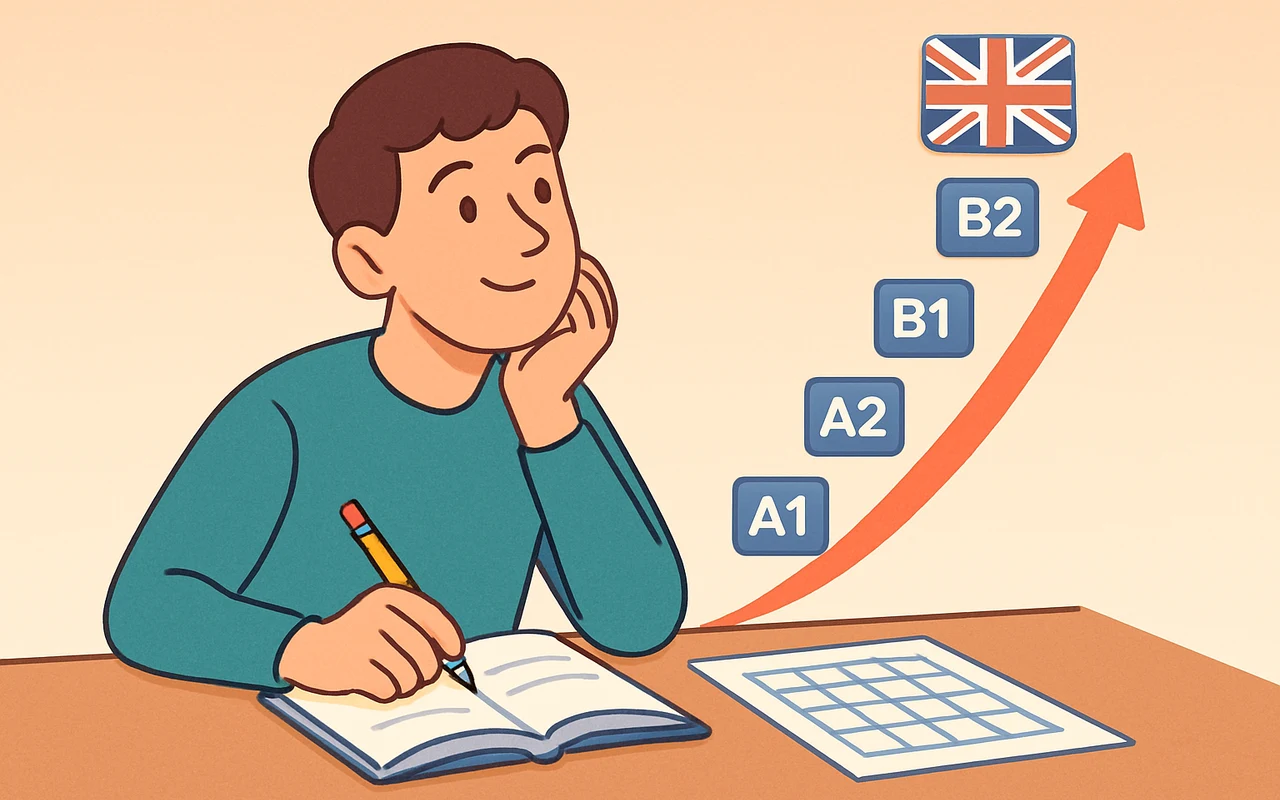
The CEFR (Common European Framework of Reference for Languages) sorts language ability into six levels: A1, A2, B1, B2, C1 and C2. B2, called "upper intermediate", is where most learners can follow complex texts, join fluent conversations and work or study in English.
Getting there from zero is largely a matter of hours. This article explains roughly how many hours each level takes, how to turn them into a schedule, and how to track them so the plan stays honest.
How Many Hours Each CEFR Level Takes
The Council of Europe, which created the CEFR, does not set official study times. The most cited estimates come from Cambridge English, which suggests cumulative "guided learning hours" (time with a teacher or structured course) for a learner starting from zero:
- A1: about 90-100 hours
- A2: about 180-200 hours
- B1: about 350-400 hours
- B2: about 500-600 hours
- C1: about 700-800 hours
These are averages, not promises. Your native language matters: a Spanish speaker meets many familiar words, while a Japanese speaker faces a very different grammar and sound system. Study quality, age, and how much English you meet outside lessons also shift the total.
Many learners also find that the later levels cost more per step. Going from A1 to A2 takes roughly 90 hours, while B1 to B2 takes around 150-200, because the vocabulary and accuracy demands grow.
Turning Hours Into a Weekly Plan
Start with the target and divide. If B2 means roughly 600 hours, your weekly pace sets the timeline:
- 5 hours a week: about 2.3 years
- 10 hours a week: about 14 months
- 14 hours a week (2 per day): about 10 months
Consistency beats intensity. Seven 90-minute sessions usually work better than one marathon on Sunday, because vocabulary needs repeated exposure over time.
Balance the Four Skills
Do not spend every hour on one activity. A simple starting split of weekly time:
- Listening: 30% (podcasts, graded videos, audiobooks)
- Reading: 20% (graded readers, news, articles)
- Speaking: 20% (tutors, language exchanges, talking to yourself)
- Writing: 15% (short daily entries with corrections)
- Vocabulary and grammar: 15% (course work, flashcards)
Adjust as you go. Beginners often benefit from more structured grammar and vocabulary at A1-A2, then shift toward listening and speaking at B1-B2.
Count Active Hours, Not Background Noise
Decide in advance what counts. A good rule is that an hour only counts if you were paying focused attention, such as pausing to look up words, repeating phrases aloud, or answering exercises. Music playing while you cook can be useful exposure, but log it separately or not at all.
Tracking Your Hours and Checking Your Level
A tracker can be very simple. A spreadsheet with columns for date, minutes, skill and notes is enough. Time trackers such as Toggl Track or Clockify help if you want to start and stop a timer instead of estimating afterward.
For flashcards, Anki uses spaced repetition (reviewing words just before you would forget them) and records daily review time, which you can add to your log.
Set Milestones at Each Level
Hours are an estimate, so verify them with evidence. When your log nears a level boundary, take a practice test for that level. Cambridge, the British Council and other providers offer free online placement tests and sample papers. Useful checks include:
- Can you understand a short podcast without transcripts?
- Can you speak for two minutes on a familiar topic without long pauses?
- Can you write a clear email or short opinion piece?
If you hit the hour mark but struggle with the test, keep going rather than moving on. If you pass early, move on sooner.
Review Monthly
Once a month, compare planned and actual hours by skill. Gaps are common: many learners log plenty of reading and almost no speaking. Moving two hours from a strong skill to a weak one is often the cheapest improvement available.
Limitations of the Hours Approach
Hour counts are a planning tool, not a guarantee. Two people can log 600 hours and end at different levels, depending on method, feedback and intensity. Passive study with no speaking or correction tends to plateau.
Also, the CEFR describes what you can do, not how long you studied. Treat the numbers as a rough map and let test results and real tasks, such as holding a conversation, decide where you stand.
Conclusion
Reaching B2 from zero typically takes about 500-600 focused hours. Dividing that figure by a realistic weekly schedule gives you a timeline, and a simple log keeps it honest.
Track hours by skill, check progress with practice tests at each level, and adjust monthly. The hours are the budget, but the tests tell you whether they are working.