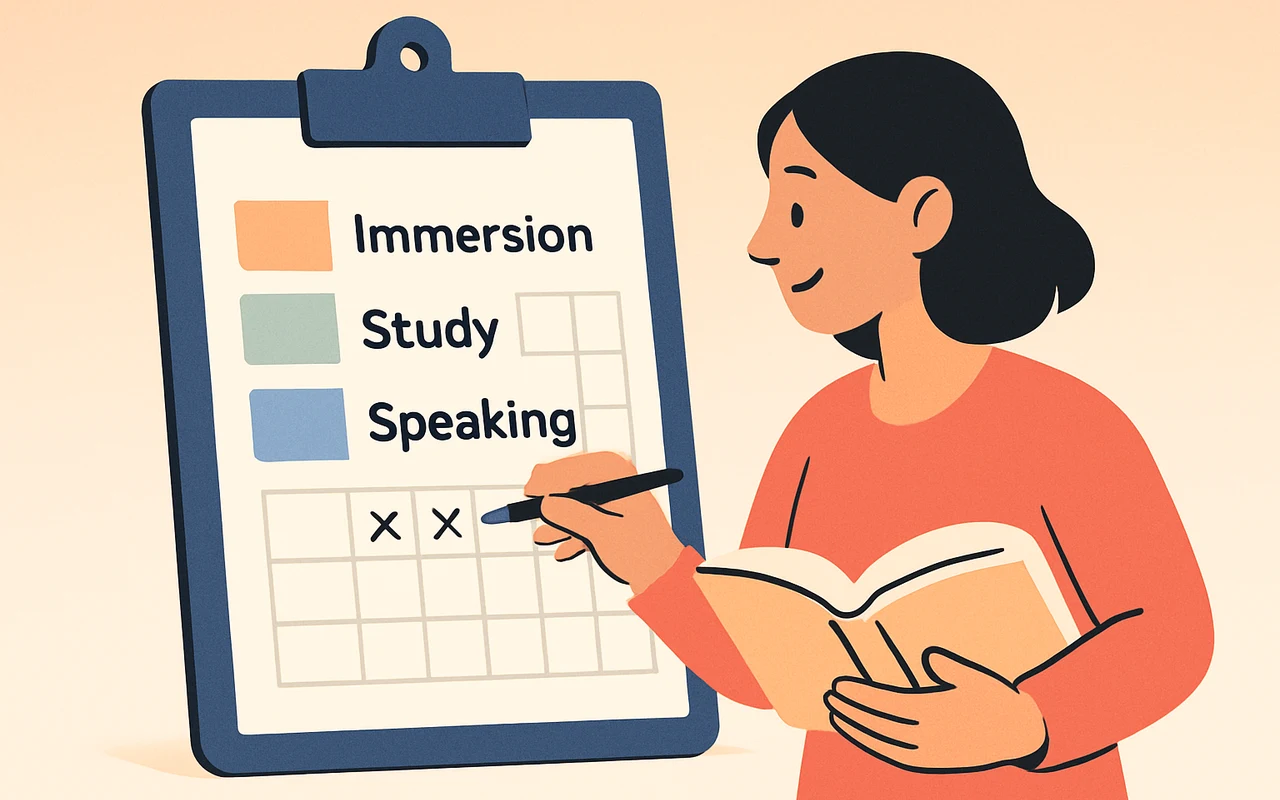
Most language learners track a single number: total hours spent on the language. It feels motivating, but it hides a lot. An hour of flashcards and an hour of conversation build very different skills.
Logging immersion, study, and speaking separately turns that vague total into a useful diagnostic. This article explains the three categories, how to record them, and what the data can tell you.
Three Categories, Three Different Skills
The split works because each type of practice trains something different. Mixing them makes it hard to see which skill is growing and which is being neglected.
Immersion
Immersion means taking in the language for meaning, without stopping to analyse it. Examples include watching a show, listening to a podcast, reading a novel, or playing a video game in the target language. It builds listening speed, vocabulary in context, and a feel for natural phrasing.
A common rule is that immersion counts only if you are paying attention and understanding at least some of it. Background audio while you cook is a gray area; many learners log it at half value or leave it out.
Study
Study is deliberate, effortful work on the language itself. This covers textbooks, grammar exercises, writing practice, and spaced repetition flashcards. Spaced repetition is a method where software, such as Anki, schedules reviews of an item just before you are likely to forget it.
Study speeds up what immersion can only provide slowly, such as grammar patterns and core vocabulary. It is also the easiest category to overestimate, because it feels like work.
Speaking
Speaking is any time you produce the language out loud with another person, or alone in a focused way. Tutoring sessions on a platform like italki, conversation exchanges, and voice chat in online games all count. Recording yourself and shadowing a speaker is a reasonable solo version.
Speaking is the hardest category to log honestly, because it is the most uncomfortable. It is also the one most learners undertrain.
How to Log the Hours in Practice
You do not need special software. A spreadsheet, a notes app, or a habit tracker with custom categories is enough. The key is to make logging take under a minute.
- Columns: date, category (immersion, study, speaking), minutes, and an optional note about what you did.
- Units: minutes are easier than fractions of hours and avoid rounding problems.
- Timing: log right after the session, not at the end of the week, when memory is unreliable.
- Timers: a simple stopwatch app helps, especially for study, where it is easy to drift into other tasks.
Tools such as Toggl Track let you create one project per category and start a timer with a click. Some learners use Language Reactor or similar browser extensions for watching video, then copy the totals into their sheet.
Decide your counting rules once and keep them. For example: a session counts only if your phone is away, subtitles in the target language count as immersion, and a tutoring lesson counts as speaking even if the tutor explains grammar for part of it. Consistency matters more than the exact rules.
What the Separate Numbers Reveal
After a few weeks, patterns appear. Suppose your log shows 20 hours of study, 15 of immersion, and 1 of speaking. You now know why you can read a menu but freeze when ordering from a waiter.
Separate logs also help you adjust. If listening feels weak, raise immersion. If you keep forgetting words, add study with spaced repetition. If you understand but cannot respond, schedule speaking sessions.
Many learners aim for a rough balance rather than equal thirds. Beginners often lean toward study, while intermediate learners benefit from shifting toward immersion and speaking. Treat any ratio as a starting point and compare it with how you actually feel in real use.
Limitations
Hours are a proxy, not a measure of skill. Twenty distracted hours can teach less than five focused ones, and the log cannot tell the difference. Categories also overlap: reading with a dictionary is both immersion and study, so pick a rule and apply it the same way every time.
There is also a risk of chasing the number. If you start choosing easy activities just to fill the log, the tracker has stopped helping. Review your results against real tasks, such as understanding a podcast episode or holding a ten-minute conversation.
Final Words
Separating immersion, study, and speaking hours costs almost nothing and gives you honest feedback on how you learn. It shows what you are doing too much of and what you are avoiding.
Start with a simple three-column log for a month, then adjust your routine based on the gaps you see. The goal is not a bigger total, but a better-balanced one.